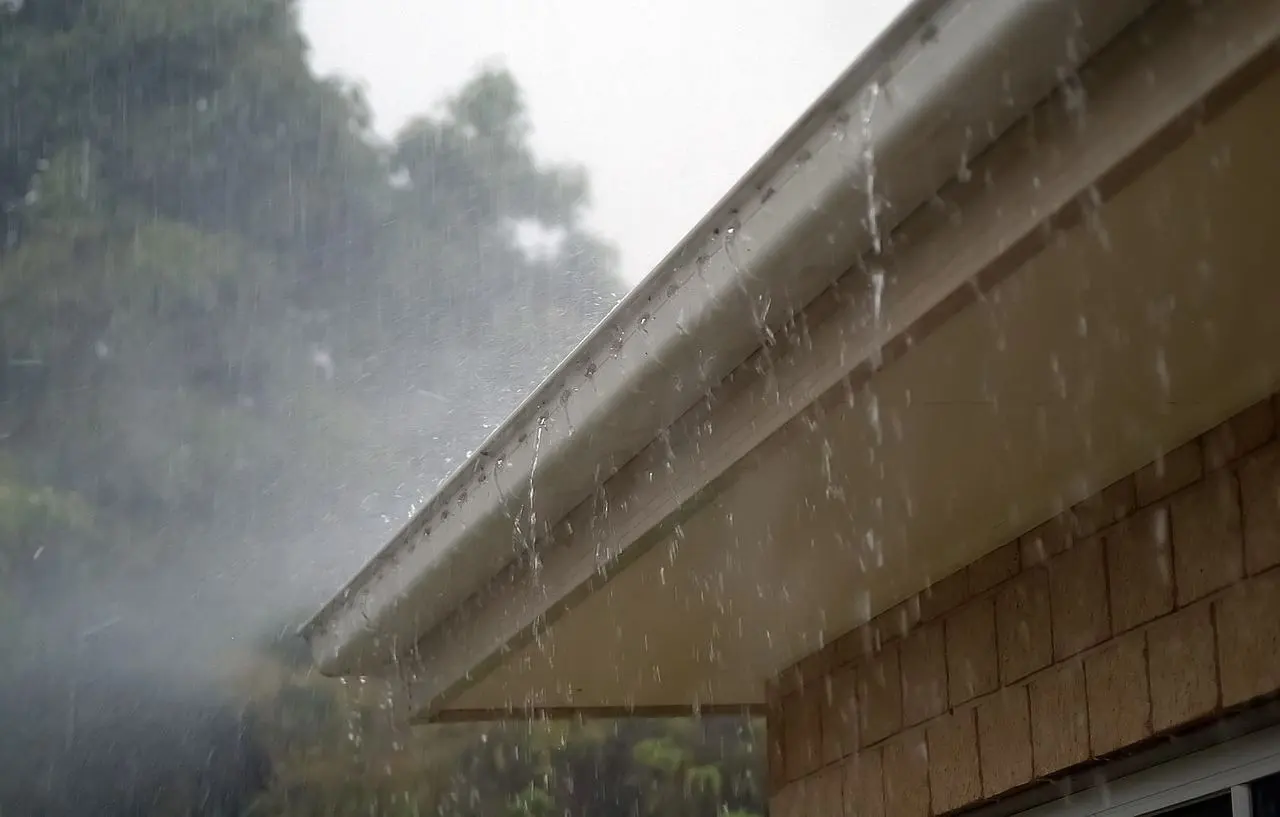
You may be asking how much rainwater can I collect from my roof before you buy a barrel. Multiply roof area by rainfall depth, a fixed conversion factor and your roof’s efficiency, and you get gallons.
This guide is part of our wider overview of rainwater harvesting, which covers collection, storage and use.
| Item | Value |
|---|---|
| Conversion factor | 0.623 gallons per inch of water height |
| Example roof area (50 feet by 40 feet) | 2,000 square feet |
| Example average annual rainfall, Santa Fe | 14 inches |
| Maximum annual capture for that example | 17,444 gallons |
| Tile or metal roof runoff efficiency | 95% |
| Asphalt shingle collection efficiency | around 85% |
The figures come from HarvestH2o’s capture system guide and Water Cache’s roof collection FAQ. They can change, so check the sources before you rely on them.
The roof rainwater formula
Water Cache gives the quick answer as one multiplication: roof area in square feet, times rainfall depth in inches, times roof collection efficiency, times 0.623, equals harvested rainwater in gallons (Water Cache).
HarvestH2o frames the same idea in two steps. First work out the maximum annual capture as annual rainfall times roof square footage times 0.623 gallons, then reduce it for real-world losses (HarvestH2o).
The 0.623 is a unit conversion, not a rule of thumb. A cubic foot of water equals 7.48 gallons, and dividing that by the 12 inches in a foot gives 0.623 gallons per inch of water height (Water Cache).
Measuring your roof footprint
For a house, the roof is the catchment. Its size decides how much rain can be caught, which in turn tells you how large the other system parts need to be (HarvestH2o).
For a rectangular roof, multiply length by width, and remember to include the overhangs. Water Cache also says not to worry about slope: rain falls straight down, so the flat footprint is what receives it. A steeper pitch changes the gutter design and the number of downspouts you may need, not the total volume (Water Cache).

How much does roof material matter?
No roof delivers every drop. HarvestH2o lists these estimated runoff efficiency ratings by roof type (HarvestH2o):
- Tile or metal: 95%
- Concrete or asphalt: 95%
- Bare soil: 75%
- Gravel: 70%
- Grass (green roof): 17%
Water Cache sees galvanized metal at a collection efficiency of at least 95%, and asphalt shingle at around 85% because rain slows on the asphalt and some evaporates. The two sources differ on asphalt, so treat any efficiency figure as an estimate (Water Cache).
If you only want the overall potential rather than a realistic yield, Water Cache says you can use 100% for the efficiency factor (Water Cache).
A worked example: a 2,000 square foot roof
HarvestH2o’s example is a single-story house 50 feet long by 40 feet wide, which gives a roof area of 2,000 square feet. It pairs that with Santa Fe, New Mexico, where average annual rainfall is 14 inches (HarvestH2o).
The maximum is 14 inches x 2,000 square feet x 0.623 gallons, which comes to 17,444 gallons, or 66,023 liters (HarvestH2o).
Now apply the roof’s efficiency. For a tile or metal roof, multiplying by 95% leaves 16,571 gallons, or 62,728 liters, of available annual harvestable rainwater (HarvestH2o). That is the realistic yield for the example, not a guarantee for any single year.
Monthly totals and the metric version
To see how collection changes through the year, run the same equation with a monthly rainfall total in place of the annual one (Water Cache). Dry months will show much smaller numbers, which matters when you plan storage.
The metric version is simpler still. Use square meters for roof area and millimeters for rainfall depth, and you need no conversion factor because the answer comes out in liters (Water Cache).
Turning the estimate into a plan
Treat your result as a ceiling for what the roof can supply. To put the number to work, read our guide on how to set up a rain barrel, then compare it with what size rain barrel or tank do i need to match storage to your roof.
Before you trust the figure, run through this short checklist:
- Use one unit system throughout: inches with square feet, or millimeters with square meters.
- Count only the roof sections whose water actually drains to your gutters.
- Use rainfall for your own area rather than a distant city’s.
HarvestH2o advises fitting screens to each downspout to keep out large debris. Choose holes larger than those of traditional window screens, because fine mesh clogs quickly and can push water over the gutters (HarvestH2o).
Rules on collecting and using rainwater vary by place, so check your local rules before you install anything.
Frequently asked questions
Why is the result an estimate rather than an exact figure?
Show answer
Some water is always lost. HarvestH2o notes that most rain is captured on common roof types, but some is lost to splashing off the roof, absorption and other factors, so the formula’s maximum is an ideal (HarvestH2o).
Where do I find my local rainfall figure?
Show answer
Annual rainfall is available online, in the local paper or from a local weather station (HarvestH2o). Water Cache points to the U.S. Climate Data website, which shows average monthly rainfall for cities across the United States (Water Cache).
Does a green roof collect much water?
Show answer
Very little. A planted roof holds back most light to moderate rain, so its efficiency is only 17%. That makes it good at slowing runoff and poor for catchment (HarvestH2o).
Does the estimate tell me the water is fit to drink?
Show answer
No. The formula measures volume only, not quality. Ask your local health authority whether and how collected rain can be used for drinking.