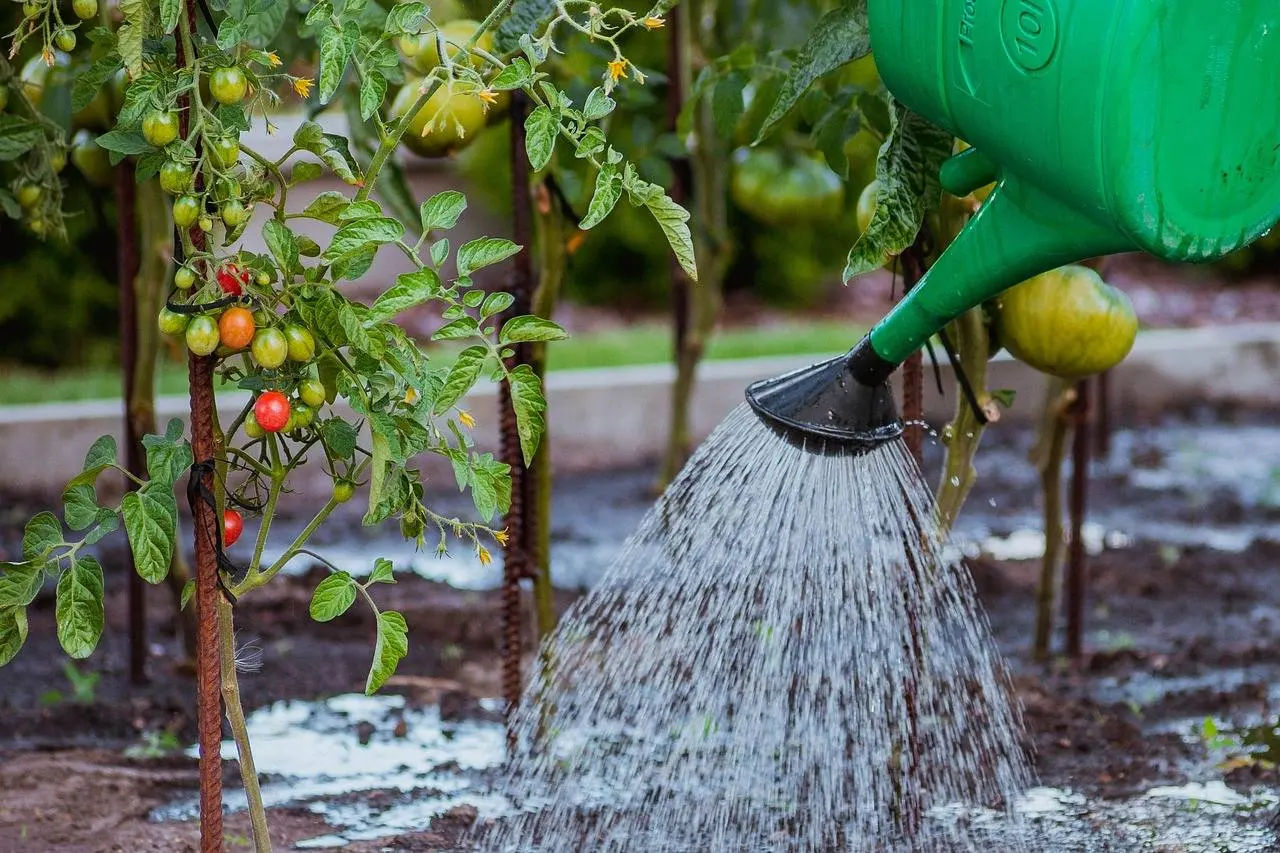
You’re asking, how often should I water my garden? Most vegetables need about one inch of water a week, given deeply and less often rather than as a daily sprinkle. Rain, soil type and plant stage shift that answer.
This guide is part of our water wise gardening series on using less water outdoors.
| Item | Value |
|---|---|
| Typical weekly need of a vegetable garden | About one inch of water per week |
| Weekly range for common vegetables in Utah | 1 to 2 inches per week |
| Example: a 10×10 garden | Around 66 gallons per week |
| Depth reached in loamy soil | 1 inch of water reaches around 6 inches deep |
| Water saved by drip irrigation | Up to about 50% |
| Mulch layer around plants | 1 to 2 inches |
These figures come from NC State Extension (Wilkes County) and Utah State University Extension. Guidance can change and local climates differ, so check the sources before you rely on them.
The one-inch weekly baseline
Most vegetable gardens need approximately one inch of water per week, excluding rainfall, according to NC State Extension in Wilkes County. Think of it as a weekly total, not a daily dose.
In volume terms, that adds up to about two-thirds of a gallon per square foot of garden space. For a 10×10 garden, the same guide puts it at around 66 gallons per week.
Utah State University Extension gives a wider range. Most commonly grown vegetables there need 1 to 2 inches of water per week, and many are sensitive to over-, under-, or irregular irrigation, as its water recommendations page explains.
How to measure an inch from your own hose or sprinkler
Guessing is the usual reason gardens get too much or too little. A simple catch-can test shows what your equipment actually delivers, using the method described by NC State Extension.
- Set a straight-sided container, such as an empty tuna can or a rain gauge, in the garden.
- Turn on your sprinkler or hose.
- Time how long it takes to fill the container to a depth of one inch.
- Use that run time each time you irrigate during a dry week.
The same trick helps you judge how well soaker hoses or drip lines perform. Drip is harder to read because emitter flow rates are listed in gallons per hour, while recommendations are given in inches per week, a gap noted by Utah State University Extension.
Why soil, season and plant stage change the answer
The weekly total stays similar, but how you split it up depends on your soil. In a loamy soil, 1 inch of water penetrates around 6 inches deep per irrigation event, according to Utah State University Extension.
Gardens with clay soil tend to hold moisture for longer and can be watered less often. Sandy soil may need frequent watering for shorter periods.
Three factors move your schedule up or down:
- Growth stage: plants that are just establishing need less water than full-sized plants that are flowering and producing fruit.
- Temperature: as air and soil temperatures rise, plants use more water to support and cool themselves.
- Soil type: clay holds water longer, sand lets it drain quickly.
Timing within the season matters too. Beans, for example, are most sensitive to drought when flowering and producing pods, so that is a poor moment to let the bed dry out.
How do you know your garden needs water?
Your fingers are a reliable gauge. NC State Extension suggests digging down about 2-3 inches with a finger or trowel: if the soil is still moist at that depth, your plants probably don’t need more water yet.
Overwatering has its own cost. It can cause root rot, fungal diseases, and weak, shallow roots, and the same page lists the warning signs:
- The soil feels soggy.
- The soil smells musty.
- The soil stays wet for hours after watering.
When you are unsure, the extension advice is to water deeply and less often instead of giving a quick sprinkle every day. Shallow daily watering keeps moisture near the surface, where it evaporates fastest.
Timing, methods and mulch that make each watering count
Early morning or late evening are generally best, while mid-afternoon watering often leads to increased evaporation, which wastes water, per NC State Extension. Our guide to the best time of day to water plants goes further on this.
The delivery method matters as much as the clock. The same source compares four common options:
- Soaker hoses lay flat on the soil and release water slowly at the root zone.
- Drip irrigation uses tubing and emitters to place water precisely, and is easy to run with a timer.
- Hand watering suits small gardens and raised beds if you water slowly and deeply.
- Overhead sprinklers suit larger areas but tend to waste water through evaporation and can wet foliage more than necessary.
Drip can cut water use by up to about 50%, according to Utah State University Extension. If you want to switch, here is how to install drip irrigation in a home garden, laid out in how to install drip irrigation.
A mulch layer of 1 to 2 inches on top of the soil around vegetable plants helps maintain soil moisture and reduce evaporation, the Utah page adds (source). If you use a timer, remember to pause it during rainy weeks so you are not doubling up.
Frequently asked questions
Is it bad to water the garden a little every day?
Show answer
Usually it is less effective than a longer soak spaced further apart. Frequent light watering wets only the top layer, so roots stay shallow and the surface loses water to the air.
Do I still water after it rains?
Show answer
Rain counts toward the week’s total, so check the soil before turning anything on. A rain gauge or straight-sided can in the bed shows how much actually fell, and the finger test shows whether it reached the roots.
Do sandy and clay gardens need different schedules?
Show answer
Yes. Per Utah State University Extension, clay holds moisture longer and tolerates gaps between waterings, while sand drains fast and does better with shorter, more frequent sessions.
Does a bigger garden need a different rule?
Show answer
The depth target stays the same, but the volume scales with area. Using the figure of about two-thirds of a gallon per square foot from NC State Extension, multiply it by your bed’s square footage to estimate a weekly total.